

Says it's a colourised version. So maybe a a fake colourisation, like they tried with certain Hollywood flims in decades past... usually causing much uproar!
[REL] Paskutine atostogu diena (1964) [Lithuania]
-
David32441
- Posts: 1099
- Likes: 575
- Joined: Thu Jul 22, 2021 2:48 am
Re: [REL] Paskutine atostogu diena (1964)
Post
by David32441 »
 0 likes

Re: [REL] Paskutine atostogu diena (1964)
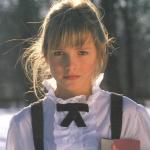
Of course it's a "fake". It has been colorized afterwards. The movie was shot in black and white in 1964.Says it's a colourised version. So maybe a a fake colourisation

Re: [REL] Paskutine atostogu diena (1964)
Is it possible to colorize a film shot in black and white? I don't really like movies made before 1970.
Some videos colorized.
https://www.youtube.com/watch?v=rUUEjqk6zPU
https://www.youtube.com/watch?v=sHkc83XA2dY
Some videos colorized.
https://www.youtube.com/watch?v=rUUEjqk6zPU
https://www.youtube.com/watch?v=sHkc83XA2dY

Re: [REL] Paskutine atostogu diena (1964)
ghost wrote: Fri Apr 21, 2023 3:41 pmOf course it's a "fake". It has been colorized afterwards. The movie was shot in black and white in 1964.Says it's a colourised version. So maybe a a fake colourisation
When you colorize a movie, you have to make choices about colors. It helps to have location or set photos in color showing what the background, skin tones, and wardrobe look like. But if you don't have those you're stuck taking your best guess. Only on rare occasions does it look entirely natural. Usually there's this pastel hued, false color, not quite right look to the altered film.
If it was shot in B&W that's usually the best way to view it.
-
Rich_Visiting

- Posts: 924
- Likes: 1010
- Joined: Sun Feb 17, 2019 8:23 pm

Re: [REL] Paskutine atostogu diena (1964)
Should it not be moved to a Lithuanian or Baltics thread? Especially since:abel wrote: Tue Apr 08, 2008 9:51 am Just a remark, the film is not Russian, it is Lithuanian. I have also a Russian version, which is for me quite understandable, but the actors are Lithuanians and speak Russian with strong foreign accent.
- they really don't wanna be confused for Russians, which I get. Canadians vs Americans and Irish vs English.
- at best it's Soviet Union, not Russia.
- The Baltic republics have a combined number of 56 entries, which are 21 Lithuanian, 13 Latvian (or 14 counting one co-production) and 22 Estonian.
Here is yet another slightly different version:
 Like this post to see ed2k links [1.73 GiB]
[Code]
 An
An 
Re: [REL] Paskutine atostogu diena (1964)
You are right that it is Soviet Union and not Russia, but here at FLM "Russia" takes the place of "Soviet Union" for classifying Soviet-era films. The terminology also matches what was used publicly in Cold War era politics and popular culture, and there are also some more disparaging terms used that I will not repeat -- but they grouped all the Soviet countries together under one umbrella term.Amadeus wrote: Tue Apr 08, 2008 10:56 am Lithuania wasn't restored to Sovereignty until the early 90s.
Like you, I also understand the desire of different nationalities to retain their distinctiveness. For films in the POST-Soviet era, I try to watch and make sure they are categorized correctly. This is of course limited by the information available.
Technically to be absolutely correct, we would need a category of Russian Empire films (pre-Soviet), Soviet Union films, and modern post-Soviet Russian films. Fortunately there probably are not any still-existing silent-era pre-Soviet Russian films that are on-topic for FLM.
It would take many hours of tedious work to no good end to ferret out all the different nations from the Soviet-era films. It would be nearly as much work to split the Russia thread into "Soviet Union" and "Modern Russia". And even when the cast and crew in Soviet films were, for example, Lithuanian, the films were generally funded by Moscow. There was no getting away from the Russian influence.
I have had similar discussions about Korea / South Korea / North Korea. I watch to make sure that Taiwanese films are labeled Taiwan, not China. Politics are a tedious BORE at a film site, but they are still a reality. No matter who may argue that they want a government to be different, it is what it is and it was what it was.
My advice to anyone is: watch the movie, it is terrific! If you want to learn more about the production history of any film, you are free to do so.